Categories
- All Categories
- Oracle Analytics and AI Learning Hub
- 53 Oracle Analytics and AI Sharing Center
- 20 Oracle Analytics and AI Lounge
- 293 Oracle Analytics and AI News
- 57 Oracle Analytics and AI Videos
- 16.4K Oracle Analytics and AI Forums
- 6.5K Oracle Analytics and AI Labs
- Oracle Analytics and AI User Groups
- 116 Oracle Analytics and AI Trainings
- 21 Oracle Analytics and AI Challenge
- Find Partners
- For Partners
How to forecast future FTE in Fusion AI Data Platform (FDI) when OOTB FTE stops at last actual?
Hi all,
In Oracle Fusion AI Data Platform (FDI), the OOTB FTE measure stops at the last actual period and does not show future months, even when I extend the date filter forward.
My question is: Should future FTE not be possible because Fusion HCM is effective-dated?
In Fusion HCM, many worker components (including assignment-related data) are date-effective with Effective Start Date / Effective End Date, meaning records can be past, current, or future-dated and should be retrievable “as of” a given date.
So if we have future-dated hires or future-dated assignment/work-measure changes, I would expect FDI to be able to compute FTE as-of future months (not just historical snapshots).
Questions:
- Has anyone managed to retrieve/plot future-dated workforce records (future hires / future assignment changes) in FDI and derive future FTE from them?
- If yes, what’s the approach: as-of/effective dating logic, a specific subject area, or a data flow/calendar scaffold pattern?
Any pointers (subject area, measure, or modeling approach) would be greatly appreciated. Thanks!
Answers
-
You can plot future workforce records using the built-in Forecast capabilities of OAC, based on different models.
How to Add a Forecast Line to a Visualization in Oracle Fusion AI Data Platform0 -
Hi Silvio,
thanks for the reply.
However, I believe this refers to a different topic. I am not looking for a statistical forecast in FDI/OAC, but for future FTE based on future-dated HCM records already stored in the system (e.g. future planned assignment/FTE changes with effective start/end dates).
Since Fusion HCM stores workforce data as effective-dated records, I expected it would be possible to derive FTE “as-of” future months in FDI.
Currently the OOTB FTE measure seems to stop at the last actual period, even when extending the time filter into the future.Do you know if there is a recommended approach in FDI to calculate FTE for future periods using these effective-dated records?
Best
0 -
Hi buddy, I understand what you want ideally, but I have suggested you use what is readily available.
On the other hand, FTE is a person count based on Assignment Status Type Code IN ('ACTIVE','SUSPENDED'). Typically those records don´t have Assignment End Date set, but you can build a report having Assignment End Date set to a future date. Would that work?0 -
Well, yes it could, if it reflects future dated changes of FTE based on an action, I guess…
0 -
Hi all,
I am also currently trying to create an FTE forecast in FDI based on already fixed measures from Oracle HCM.
As far as I understand Oracle HCM, there is no out-of-the-box (OOTB) solution for this use case, so the forecast needs to be built using calculations.
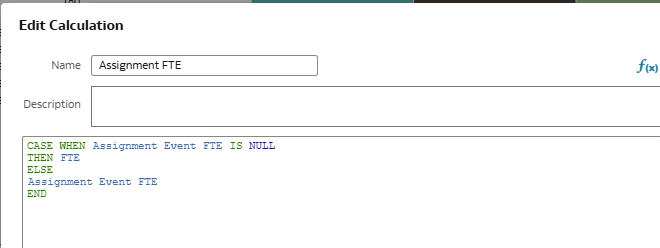
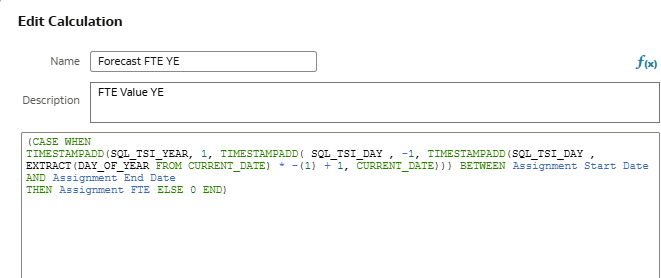
So far, I have used the calculations mentioned below on the HCM – Workforce Core database (the forecast horizon is until the end of the current year). In the background, I am also filtering on Primary Flag = Y and Assignment Status Type Code = Active.
This approach works for most employees. However, it does not work correctly for employees who are still active in the future and have multiple future events or actions. In cases where there are two future events, it appears that the forecasted FTE is doubled.
Is there an additional filter or recommended logic that can be applied to avoid this issue (for example, to ensure only the relevant future assignment record is considered)?
Does anyone have a suggestion or solution for handling cases with more than one future event or action?
0 -
Maybe, you can identify the greatest effective start date. So you can filter to select only the one with the maximum (effective start date) that is ≤ the forecast date? Not sure if there is a default filtering option for latest effective change.
0 -
As far as we can see, there is no out‑of‑the‑box “effective latest change date” available in FDI.
We also haven’t identified any alternative standard date field that could be used to derive this logic automatically.If anyone is aware of a different approach, hidden standard attribute, or best practice to handle this scenario, we’d be very interested to hear your suggestions.
0 -
A calculation for maximum (effective start date) that is ≤ the forecast date
and use its FTE only could work to get the effective latest change date. But I might be wrong.0