Hi All,
Can we use CSS in FAW or any idea how to implement it here.
Regards,
Ravi
Hello Ravi,
Yes, you can use CSS (Cascading Style Sheets) for customization in FAW (presumably Frequently Asked Questions or a similar context). To implement CSS, follow these steps:
1. Inline CSS: You can apply CSS directly within the HTML tags. For example:
```html
<p style="color: blue; font-size: 16px;">This is a customized paragraph.</p>
```
2. Internal CSS: You can also embed CSS within the HTML document using the `<style>` tag. Place this tag within the document's `<head>` section.
<head>
<style>
p {
color: blue;
font-size: 16px;
}
</style>
</head>
<body>
<p>This is a customized paragraph.</p>
</body>
3. External CSS: Create a separate CSS file (e.g., style.css) and link it to your HTML document.
<link rel="stylesheet" type="text/css" href="style.css">
In style.css:
```css
Ensure that you have the necessary permissions to apply custom styles, and consider any platform-specific restrictions. Experiment with these methods to achieve the desired customization in your FAW.
Best regards,
[Iqra Technology]
The above comments are true for OTBI but not for FAW/FDI. There is a template feature being considered that would be able to apply a predefined color palette across a number of reporting elements but it would not be css directly.
What is the css intended to be used for?
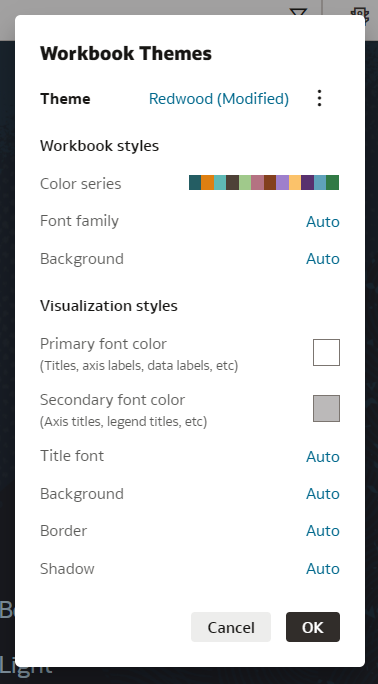
Revisiting this topic, I can share that Themes and Layouts are now present in OAC and FAW. Themes provide a predictable and safe way to share cosmetic attributes across multiple workbooks. I'll also note that outside of themes, logos can be added to workbook headers also.
Layouts also provide a means to set up shared, layouts for workbook structure that can be used as a starting point for content and to provide consistency for common patterns. Any number of these can be created by users and shared.
Unlike OTBI we do not intend to add random inserting of html and other code due to concerns around page code stability, XSS exploits, SQL-injection hacks, etc.
Dave
Currently, scheduling functionality is available primarily for workbooks and dashboards developed using the Classic reporting method. Extending similar scheduling capabilities to workbooks and dashboards developed using Data Visualization (DV) would significantly improve the usability and adoption of these reporting…
Fusion App data is frequently refreshed from our Fusion Production environment. As a result, in order to sync the data in our FDI non production environments a full reload is needed. Due to volumes of our Fusion Production, the task to perform reload of the data will take 1-2weeks to complete. Depending on the frequency,…
Hi All, I see several upcoming changes in Fusion HCM Core HR, including new employee attributes such as Preferred First Name and Preferred Last Name. Since we have multiple Oracle FDI workbooks currently live with business users, we need to assess whether these HCM changes have any downstream impact on our existing…
Requesting a toggle to suppress zeroes and nulls in tables and pivots in similar fashion to that of SmartView functionality. Currently there is native suppression, but this functionality rarely excludes zeroes appropriately resulting in many rows of non-meaningful data. Filtering zeroes out is theoretically an option, but…
Idea Enhance FDI Custom Data Security to allow permitted data values to be configured directly within a Data Role, rather than requiring all values to be granted separately through user-level Security Assignments. Use Case Our organisation uses row-level data security based on Chart of Accounts segment values that align to…