Enterprises today have access to powerful foundational LLMs, but the real challenge lies in unlocking their value by connecting them to enterprise data. The Knowledge Base feature in AIDP Workbench, currently in Preview, addresses this need by enabling AIDP agents to access and utilize organizational knowledge. In this post, we'll explore what Knowledge Bases offer, common use cases, key benefits, and best practices for getting started.
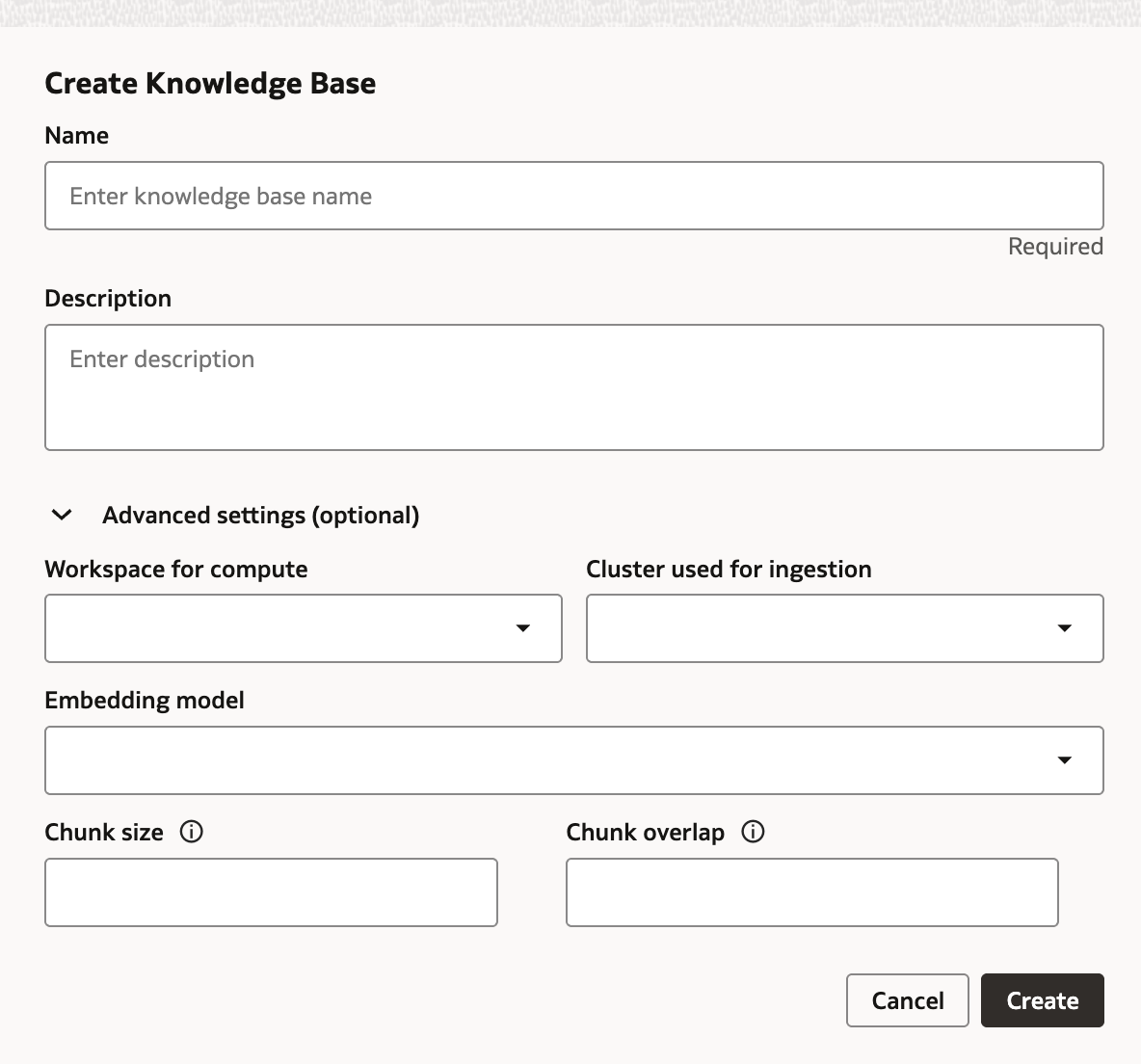
What Are Knowledge Bases in AIDP?
Knowledge Bases in AIDP Workbench provide the foundation for AI agents to access, search, and reason over curated enterprise knowledge through deeper semantic retrieval grounded in your actual content rather than just keywords. This is achieved by leveraging Oracle Database 23ai’s native Vector Search: documents such as PDFs, DOCX, and TXT are ingested from managed or external volumes in your standard catalog and automatically transformed into vector embeddings using integrated models (ALL_MINILM_L12_V2 and MULTILINGUAL_E5_SMALL). These embeddings are stored in the database, powering efficient contextual search and enabling AI agents to deliver precise, knowledge-grounded answers.
How AI Agents Use Knowledge Bases
Knowledge Bases play a critical role in enabling AI agents to deliver contextually relevant and trustworthy responses grounded in an organization’s own data. Knowledge Bases are not queried directly by users. Instead, AI agents interact with them via the Retrieval Augmented Generation (RAG) tool (Preview). For example, a product support agent would be able to accurately answer questions about a product based on its technical documentation. When an agent receives a user question, the RAG tool semantically searches Knowledge Bases, retrieves relevant document chunks, and supplies them as context to the generative model. This enables more accurate responses specifically grounded on the enterprise’s documentation, policies, or other internal sources.
Key benefits:
- Agents can answer questions based on enterprise documents, policies, contracts, or help articles.
- By grounding responses in authoritative documents, hallucinations are reduced and answers better reflect organizational knowledge.
- Ingests diverse document formats commonly used in business (PDF, DOCX, TXT).
- Understands context and intent, not just literal matches.
Example use cases:
- Internal policy assistants referencing HR/IT manuals.
- Customer support bots accessing technical documentation.
- Compliance agents surfacing relevant regulations from legal archives.
Conclusion
Knowledge Bases represent an important step toward enterprise-grade agentic solutions in Oracle AI Data Platform. By enabling agents to reference your organization’s trusted documentation, you can build smarter, safer, and more valuable AI-powered solutions for employees and customers alike.
Disclaimer: Agent Flows, Knowledge Bases, and RAG features mentioned in this article are currently in LA and are subject to change.

