Does anyone know if there's a way to refresh a Repository variable on demand? There is an option to define the refresh frequency, but I couldn't find a way to refresh it manually.
Hello,
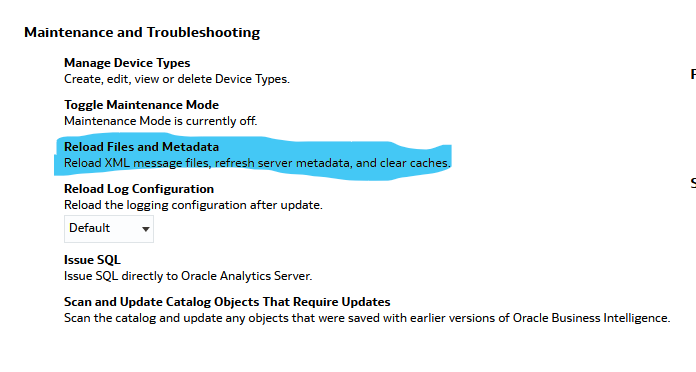
In Oracle Analytics Cloud (OAC), the "Reload Files and Metadata" action is the standard administrative operation used to refresh the RPD (repository) in online mode and applies any changes, including updates to repository variables.
https://docs.oracle.com/en/cloud/paas/analytics-cloud/acabi/classic-administration-page.html
@DeepaliG-Oracle , I do not think we can refresh it manually.
If it is a static repository variable, it's value is initialized in the Variable dialog.
The value of the static repository variable persists and doesn't change until an administrator decides to change it. For example, suppose you want to create an expression to group times of day into different day segments. If Prime Time were one of those segments and corresponded to the hours between 5:00 PM and 10:00 PM, you could create a CASE statement like the following:
CASE
CASE WHEN "Hour" >= 17 AND "Hour" < 23 THEN 'Prime Time' WHEN... ELSE...END
If it is a dynamic repository variable, it can be initialized in the same way as static variables, but the values are refreshed by data returned from queries.
When defining a dynamic repository variable, you create an initialization block or use a preexisting one that contains a SQL query. You also set up a schedule that the Oracle BI Server uses to run the query and periodically refresh the value of the variable. When the value of a dynamic repository variable changes, all cache entries associated with a business model that reference the value of that variable are purged automatically.
Each query can refresh several variables, one variable for each column in the query. In Oracle BI Server, create a schedule to run the queries.
Please refer this doc for more details. Hope it helps!
Thanks @Henry Cabrera @SteveF-Oracle @RVohra, for your answers. Let me review and analyze what fits for our use case.
@DeepaliG-Oracle feel free to share your analysis here. It will help community in long run. Thanks
There is no native “Refresh Now” button for Repository Variables in Oracle Analytics.
Repository variables (especially dynamic ones) are refreshed only through:
They are evaluated and stored at the BI Server level, not at the dashboard/runtime layer. So dashboards, prompts, and analyses have zero control over forcing a refresh.
Use these options given below
If you truly need on-demand refresh logic, session variables are much more flexible.
Why?
This is usually the recommended design if the value must reflect near real-time logic.
In the init block settings, you can:
But downside:
If my response has answered your question, please mention the thread as Accepted Answer as this will help the community members on the solution
Learn how to deploy an AI Data Platform agent, register it to the AI Registry, and introduce it to business users through Agent Hub. This session covers how to prepare an agent for deployment, configure endpoint access and authentication, invoke a deployed agent, and monitor it after deployment. The session also introduces…
Can you please help resolve this error. WebLogic version is 12c. OAS is 6.4
So I have an action passing a value to another workbook. On the other workbook, I have an expression filter and a parameter I created and it does not seem to work. Any ideas. See the images
We know you can directly export workbooks and folders from within OAC, and we know you can migrate OAC content using the FDI Content bundle. However, it's unclear what settings or steps are required in order to ensure any calculations in "Shared Objects" still carry over. When making a .dva artifact export from OAC for…
The user icon in the upper-right corner of OAC (DV) is displaying more menu options for our non-admin users than we wish to display. We would like to restrict these to only "Profile" and "Sign Out" for regular users. Is there a way to customize these menu items? Especially if we can control this via security, that would be…
What is wrong with this code