What is cervical cancer?
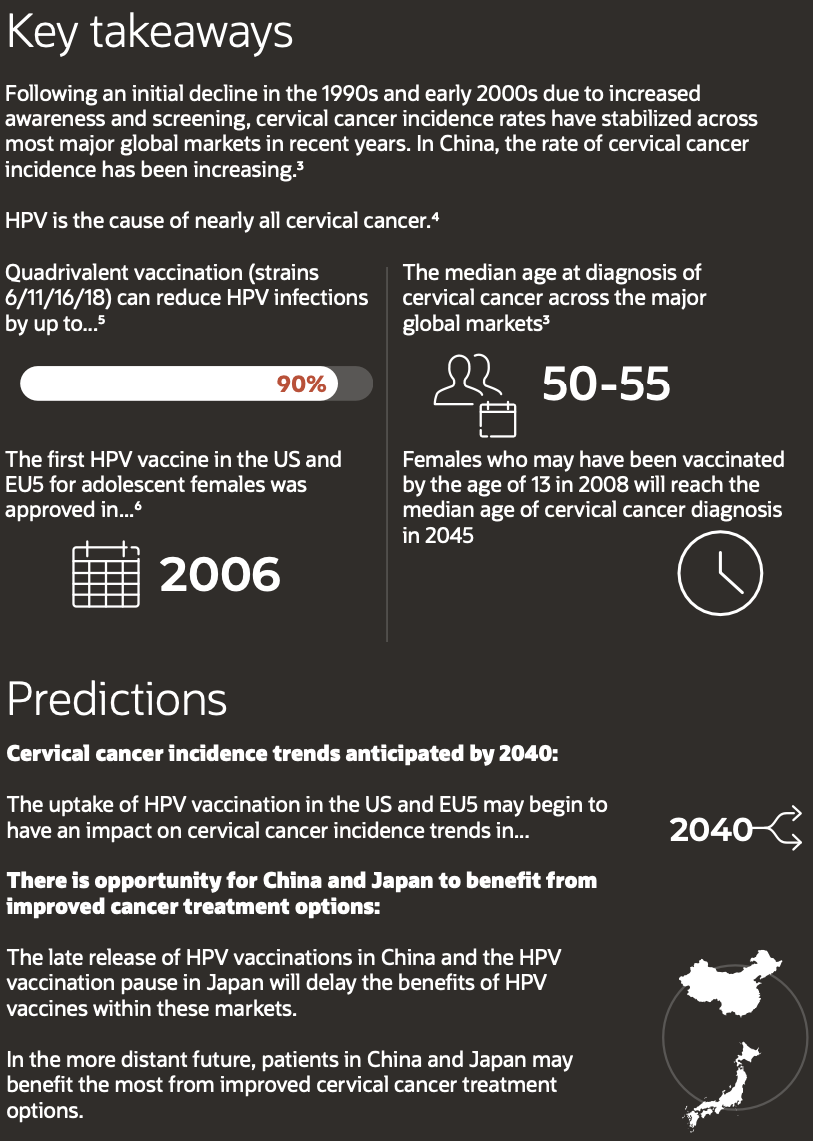
Cervical cancer is a type of cancer that develops in the cells of the cervix. Risk factors for developing cervical cancer include human papillomavirus (HPV) infection, exposure to diethylstilbestrol (DES) in utero, having three or more full-term pregnancies, young age at first full-term pregnancy, smoking, and long-term use of oral contraceptives. In contrast, use of an intrauterine device (IUD) is associated with a decreased risk of cervical cancer.[1] HPV infection is the most important cervical cancer risk factor.
Certain low-risk strains of HPV may cause genital and anal warts, whereas high-risk HPV strains are frequently linked to cervical and other cancers.[1]
The average time from initial exposure to development of cervical cancer is 15 years.[2]
2023 Incidence rates in major global markets [3]:

Case study - The historical impact of HBV vaccination on HCC incidence
Background
Similar to the connection between HPV and cervical cancer, the hepatitis B virus (HBV) is indicated in the majority (55%) of all cases of hepatocellular carcinoma (HCC).[8] HBV causes acute and chronic liver disease, including Hepatitis B, cirrhosis, and HCC. The virus is spread via bodily fuids.[9]
There is a longer latency period between HBV infection and HCC than what is seen between HPV and cervical cancer. Studies in Japan and the US have reported an average time between HBV and HCC development of approximately 30 years.[10]
HBV is preventable with a vaccine, which was first developed in the early 1980s.[11]
Data from various studies across Taiwan, China, The Gambia, and the US (Alaska) have either shown decreased incidence in HCC as a result of vaccinations or are expected to show statistically significant differences in the coming years.[12]
Key takeaways
The HBV vaccine was available approximately 25 years before the HPV vaccine and has had uptake challenges globally.
The period from HBV infection to HCC development is on average 2x longer than that of HPV infection to cervical cancer development.
The impacts of vaccination on HCC development only began appearing in the research in the early 2010s, 30 years after vaccine development. The research is still lacking across many regions and populations.
Prediction as it relates to HPV/Cervical cancer
We expect to see a similar trend of lag between vaccination development, rollout, and eventual impact on disease development for HPV vaccines and cervical cancer, taking into account differences between the latency period and vaccine rollout.


- American Cancer Society (www.cancer.org), accessed March 2023
- Meijer CJ, Snijders PJ, van den Brule AJ. Screening for cervical cancer: should we test for infection with high-risk HPV?. CMAJ. 2000;163(5):535-538.
- Cerner Enviza CancerMPact® Patient Metrics, accessed March 2023. Note that incidence rates provided here from Patient Metrics are crude incidence rates
- de Martel C, Plummer M, Vignat J, Franceschi S. Worldwide burden of cancer attributable to HPV by site, country and HPV type. Int J Cancer. 2017;141(4):664-670. doi:10.1002/ijc.30716
- Garland SM, Kjaer SK, Muñoz N, et al. Impact and Effectiveness of the Quadrivalent Human Papillomavirus Vaccine: A Systematic Review of 10 Years of Real-world Experience. Clin Infect Dis. 2016;63(4):519-527.
- doi:10.1093/cid/ciw354
- Cerner Enviza CancerMPact® Treatment Architecture, 2022
- Qiao J, Wang Y, Li X, et al. A Lancet Commission on 70 years of women's reproductive, maternal, newborn, child, and adolescent health in China. Lancet. 2021;397(10293):2497-2536.
- doi:10.1016/S0140-6736(20)32708-2
- de Martel C, Georges D, Bray F, Ferlay J, Clifford GM. Global burden of cancer attributable to infections in 2018: a worldwide incidence analysis. Lancet Glob Health. 2020;8(2):e180-e190.
9. World Health Organization (https://www.who.int/news-room/fact-sheets/detail/hepatitis-b), accessed April 2023.
10. Michielsen PP, Francque SM, van Dongen JL. Viral hepatitis and hepatocellular carcinoma. World J Surg Oncol. 2005;3:27. Published 2005 May 20.
doi:10.1186/1477-7819-3-27
11. Romano' L, Zanetti AR. Hepatitis B Vaccination: A Historical Overview with a Focus on the Italian Achievements. Viruses. 2022;14(7):1515. Published 2022 Jul 11.
doi:10.3390/v14071515
12. Flores JE, Thompson AJ, Ryan M, Howell J. The Global Impact of Hepatitis B Vaccination on Hepatocellular Carcinoma. Vaccines (Basel). 2022;10(5):793. Published 2022
May 17. doi:10.3390/vaccines10050793
13. Haruyama R, Obara H, Fujita N. Japan resumes active recommendations of HPV vaccine after 8·5 years of suspension. Lancet Oncol. 2022;23(2):197-198.
doi:10.1016/S1470-2045(22)00002-X
14. World Health Organization (www.who.int), accessed March 2023
doi:10.1016/S2214-109X(19)30488-7
2953295168_HPV Vaccination Infographic_v1_June2023
Copyright © 2023 Oracle and/or its affliates. All rights reserved.