OAC AI Agents empower organizations to analyze data and answer complex business questions with speed and intelligence. However, as adoption grows, a critical challenge becomes clear: raw data rarely reflects how the business actually thinks. Different departments use different terminology. Regions apply distinct classifications. Executive reporting often requires specific groupings, curated visualizations, or presentation formats that go beyond the structure of the underlying dataset.
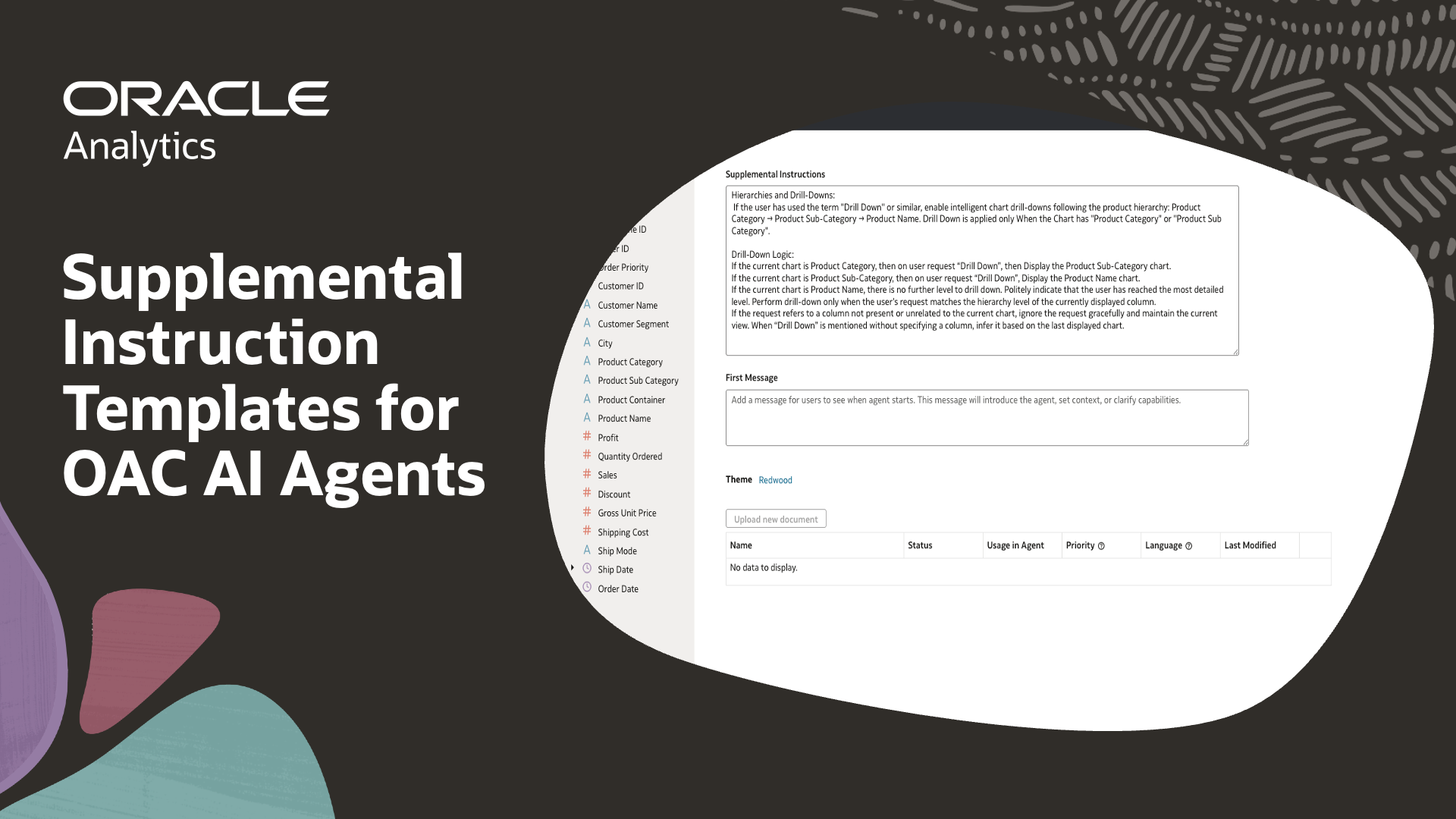
Without clear guidance, AI systems interpret data literally — rather than contextually. As a result, Insights are technically correct, but are not aligned with business intent. To address this gap, we can use the Supplemental Instructions. The templates shared in this post are examples that show you how you can influence AI to interpret, group, calculate, and present data — according to your own business logic. This ensures that insights are not only accurate — but aligned, consistent, and business-ready.
The templates for Supplemental Instructions at the following link. Some of these templates include: Fiscal Calendars, Grouping of Attributes, Hierarchies and Drill-Downs and so on. Instead of rewriting instructions repeatedly, these templates provide quick guidance to set up instruction in line with your business.
Note: These templates are provided as reference examples only. They are intended to demonstrate common instruction patterns and may require modification to align with your policies, and reporting standards. Oracle recommends reviewing and validating all instructions in a controlled environment before deploying them to production.
Check out the post below


