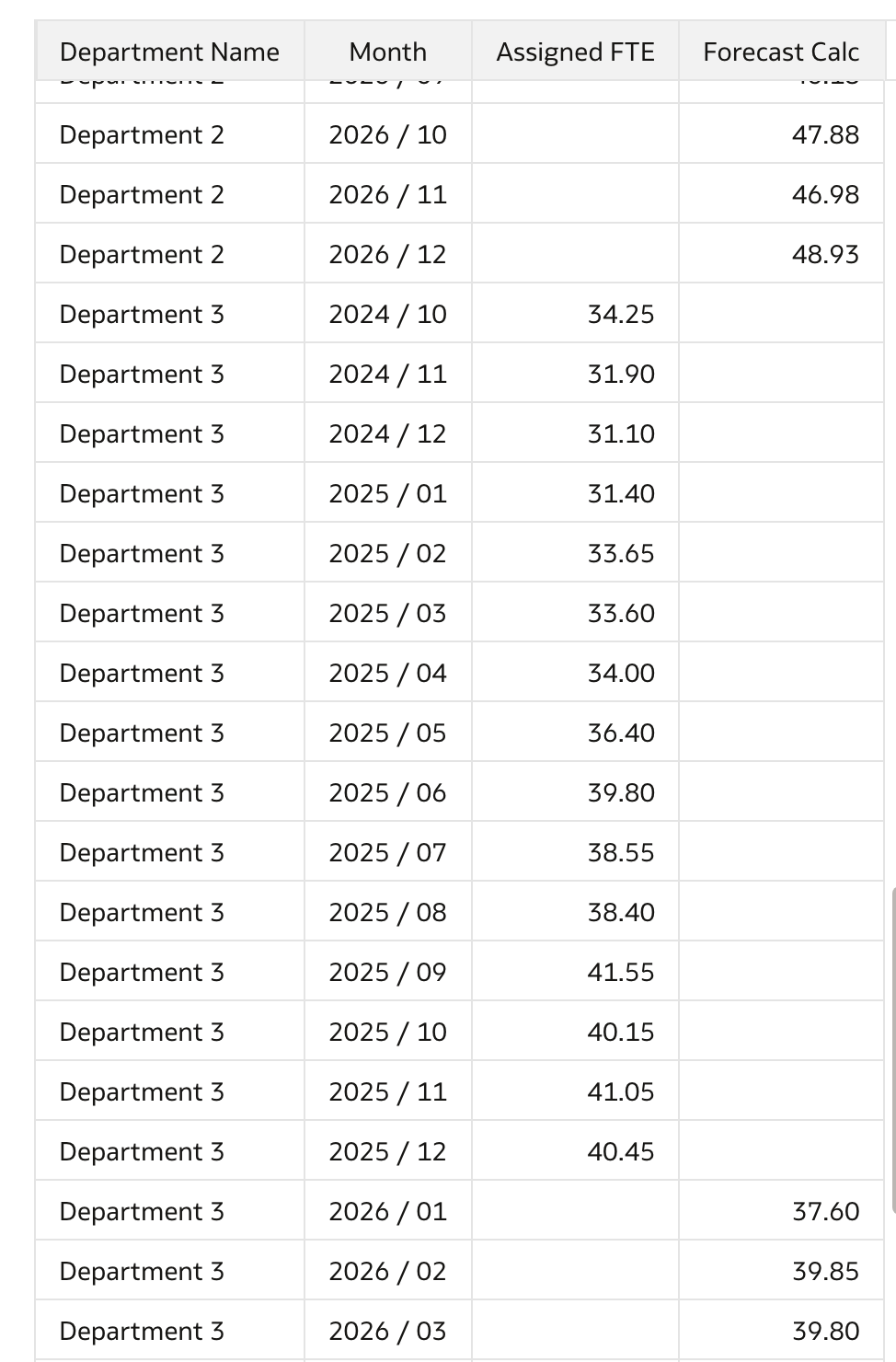
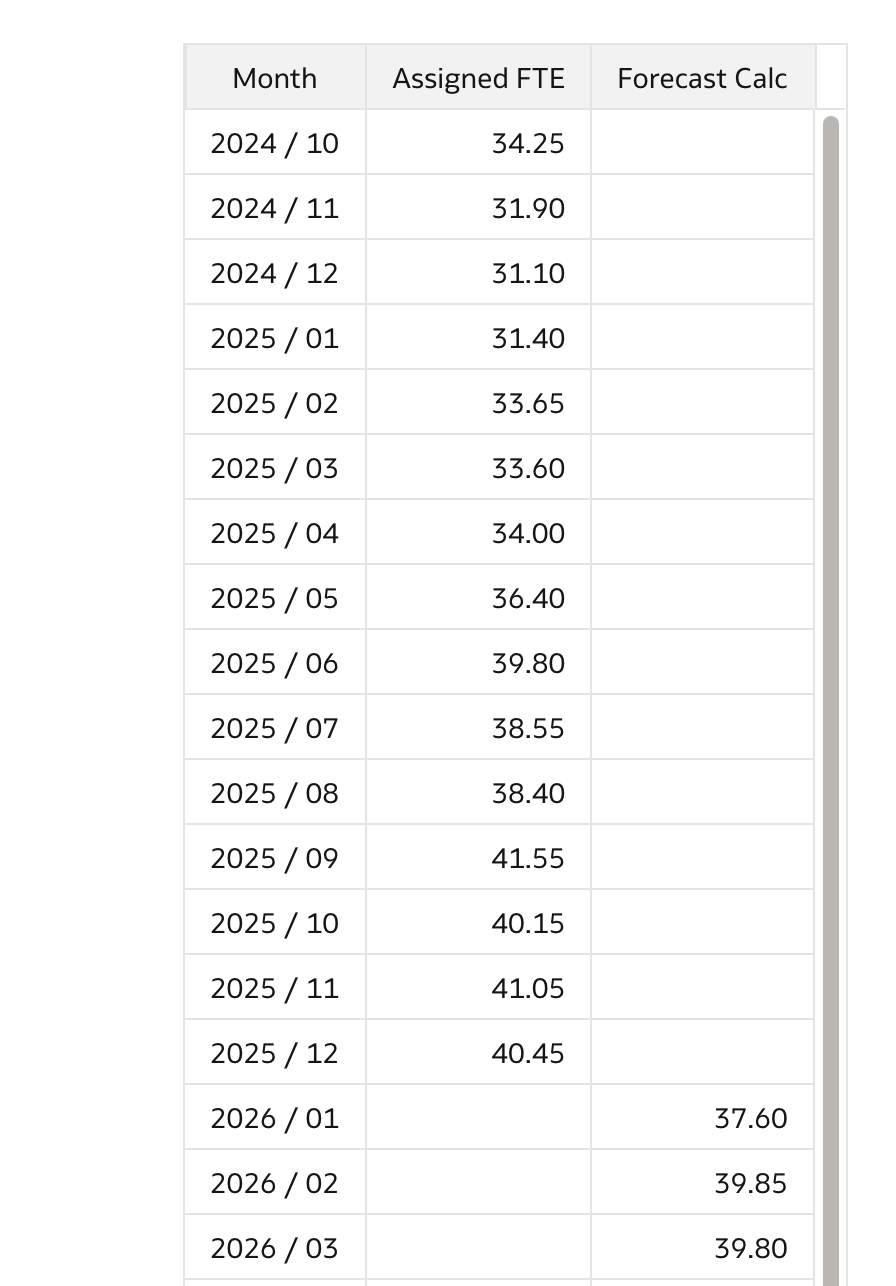
Enable users to export or view in a table format the forecasts generated from graphs using ETS, ARIMA, or Prophet models.
@Gina DiVenti
Thanks for your patience and the quick reply. I wasn’t able to reproduce the issue on my side, which makes me think there might be some underlying aggregations or other factors affecting the calculation.
To move forward, we have a couple of options:
I have separated Department 1 Data and stored it as a separate file. Below are the predictions when we have only department 1 data.
I see exactly same values when I use the same values. Explanation for Lower Values in Initial Forecasts:
The lower values in the initial forecast occur because an ARIMA model is being used. In ARIMA, the autoregressive (AR) component places greater weight on recent observations, while the moving average (MA) component smooths the series by incorporating past forecast errors. Recent historical values are in the mid-30s, the model anchors the early forecast periods around these levels. As a result, the projected values in the immediate future appear slightly lower before gradually adjusting over time.
In scenarios where strong trend or seasonality effects are present, a Prophet model is often more suitable, as it explicitly models trend changes and seasonality and can adapt more quickly to such patterns.
@Laxminag Mamillapalli I just realized I stumbled upon this solution to my problem in the OAC idea lab, but I am working in FDI. I'm assuming this should still work in FDI since the forecast feature exists, but wondering if that is the difference. Does that change anything regarding next steps (options you presented above)?
FDI data has aggregations and slightly more complex scenarios which may have influenced. At this point I can only speculate. Please feel free to raise a bug and explain the conditions. Make sure add as many details about build, versions, environment etc to narrow down. Have a great day.
@Luis E. Rivas -Oracle can you connect with @Laxminag Mamillapalli and@Lalitha Venkataraman-Oracle to see if we have an internal repro of if we need more information.
and
We want to increase the rest api limit for this payload to incease from current 25 limit to 100. we are calling this api through RF Smart and due to limitation for paging size, the packing units more than 25 does not show up. Can you please increase the limit atleast to 100.…
We have observed a potential issue with dataset refresh schedules when changing the Data Access mode. When a dataset is configured with Automatic Caching, a reload schedule can be defined to refresh the data at specified intervals. However, if the Data Access setting is subsequently changed from Automatic Caching to Live,…
Would like for the old classic BIP bursting feature to be fully Agent aware so that end users no longer need to be concerned with scheduling via the classic console or building out as many BIP reports just to support this one thing.
We have various data sources in Microsoft Fabric and need the ability to build reports in Oracle Analytics Cloud that connect to data sources in Microsoft Fabric. This is an unavoidable reality in today's complex data ecosystems. Microsoft Fabric requires authentication via Microsoft Entra. We opened an SR and Oracle told…
With the OAC Visualization AI Skill, users can potentially extend existing custom visualizations and address limitations encountered in real-world use cases. As an example, we used the AI Skill to enhance the OracleVectorMapsH3 visualization from approximately 10,000 data points to a version supporting up to 50,000 data…