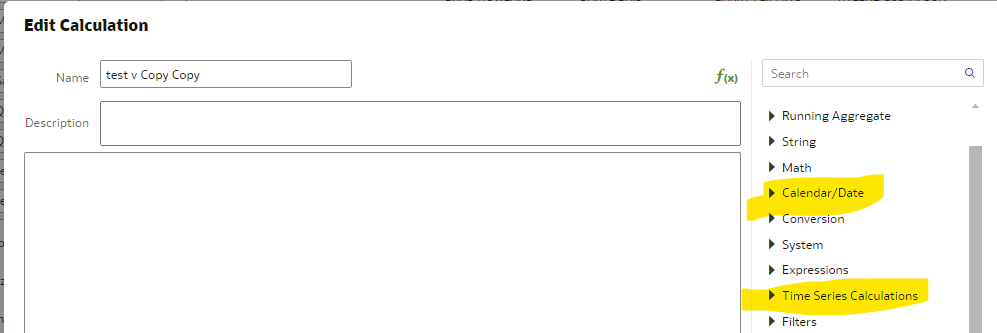
Greetings Community, is there any workaround possible that returns "Number of Days" in a Month. For ex, March = 31, April = 30 and so on and so forth.
I've tried many combinations from here:
but nothing seems to work.
Hi,
You need to start from a date, being a day in the month and year you need to know the number of days (because February has different days depending on the year).
Then, what you can do is to add 1 month to that date and remove the number of day of the month of your date and get the number of day for the date you got (it was the end of the month).
Here an example using CURRENT_DATE:
DAYOFMONTH(TIMESTAMPADD(SQL_TSI_DAY, DAYOFMONTH(CURRENT_DATE)*-1, TIMESTAMPADD(SQL_TSI_MONTH, 1, CURRENT_DATE)))
You can easily apply this formula to any date you have.
Just keep in mind that it would faster and "safer" (every user will always get the right number) if you add that information to your time dimension as an attribute.
Do you know if connections that do not use TLS will be affected by the September 2026 update? Regards, Alison.
Hi Team, We would like to raise an enhancement request for the SSO/SAML configuration guidance for OAS 2026. We have already raised multiple SRs regarding OAS 2026 SSO configuration. However, we are facing difficulties getting the required guidance, as the available documentation does not clearly cover the OAS 2026 SSO…
We are planning to archive the Contract and Lease data currently sourced from the External Source as Contract and Lease accounting functions are being migrated to Oracle's CLM and Lease Accounting modules. At this stage, only active and partially closed records are being converted into Oracle and the remaining historical…
The difference column is a calculation, and I would like to average that row.
We are trying to convert our OAS reports to OAC and one of the parameters in the where clause of the report is what I am trying to make in OAC. I created a calculation as follows and I am trying to put it into a filter . The code validates EVALUATE('GREATEST ( TRUNC ( NVL (%1, TO_DATE (''1/1/2013'', ''mm/dd/yyyy'') ) ),…