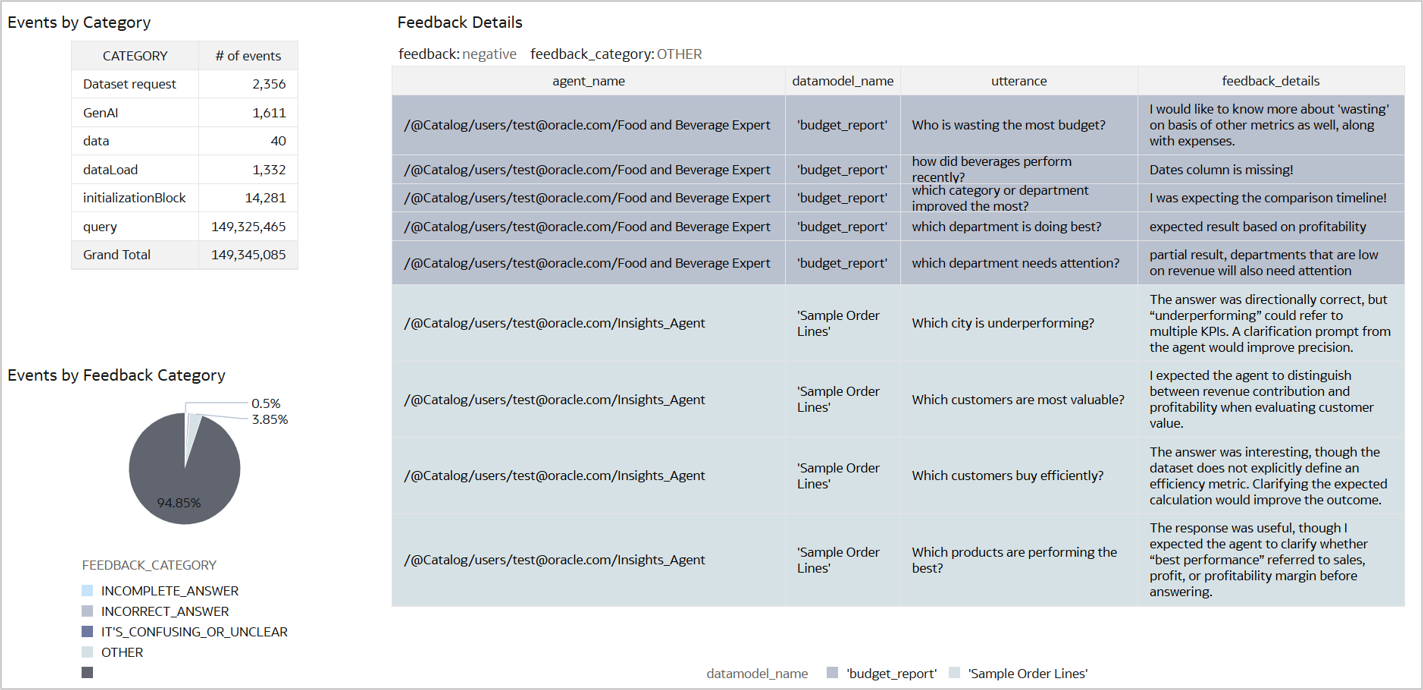
Understanding how users interact with Oracle Analytics AI Assistant — including the questions they ask, the responses they rate positively or negatively, and the datasets or agents involved — is essential for continuously improving AI-driven analytics experiences. Capturing and analyzing this feedback enables content authors and administrators to refine semantic models and datasets, improve AI Assistant response quality, and deliver more accurate, contextual, and trusted conversational analytics experiences.
This two-part blog series demonstrates how to build a complete monitoring and analytics framework for Oracle Analytics Cloud (OAC) AI Assistant using Oracle Cloud Infrastructure (OCI) Logging, Oracle Autonomous AI Lakehouse, and Oracle Analytics Cloud.
Together, these blogs guide you through the complete journey — from capturing raw OAC diagnostic logs and transforming them into analytics-ready structures, and finally deriving actionable insights from AI Assistant interactions and feedback patterns.
Blog 1 – Unlocking Oracle Analytics Cloud Diagnostics with Oracle Cloud Infrastructure Logging
The first blog focuses on establishing the logging and diagnostic foundation required for AI Assistant monitoring and analysis. It explains how to:
- configure OAC diagnostic logging using OCI Logging
- capture and explore AI Assistant interaction and reaction logs using OCI Log Explorer
- analyze diagnostic logs such as user utterances, feedback signals, dataset context, and generated responses
- export and retain logs using OCI Object Storage for downstream monitoring and troubleshooting
This foundational setup provides the centralized logging framework for deeper AI Assistant interaction analysis.
Blog 2 – Analyze Oracle Analytics Cloud AI Assistant User Feedback Using Oracle Cloud Infrastructure Logs
Building on the logging and transformation framework established in Blog 1, the second blog demonstrates how to analyze OAC diagnostic logs to better understand AI Assistant usage, feedback patterns, and adoption trends.
This blog shows how to:
- build OAC dashboards to monitor AI Assistant interactions and feedback activity
- analyze user utterances, feedback responses, and AI Assistant usage patterns
- identify frequently failing or negatively rated interactions for faster troubleshooting
- improve AI Assistant accuracy and usability through data-driven feedback analysis
By combining the workflows from both blogs, organizations can establish a scalable monitoring and feedback intelligence framework for Oracle Analytics AI Assistant, enabling continuous improvement of AI experiences, datasets, metadata models, and conversational analytics outcomes.