
Best Of
Re: Browser cache issues after PeopleTools upgrade
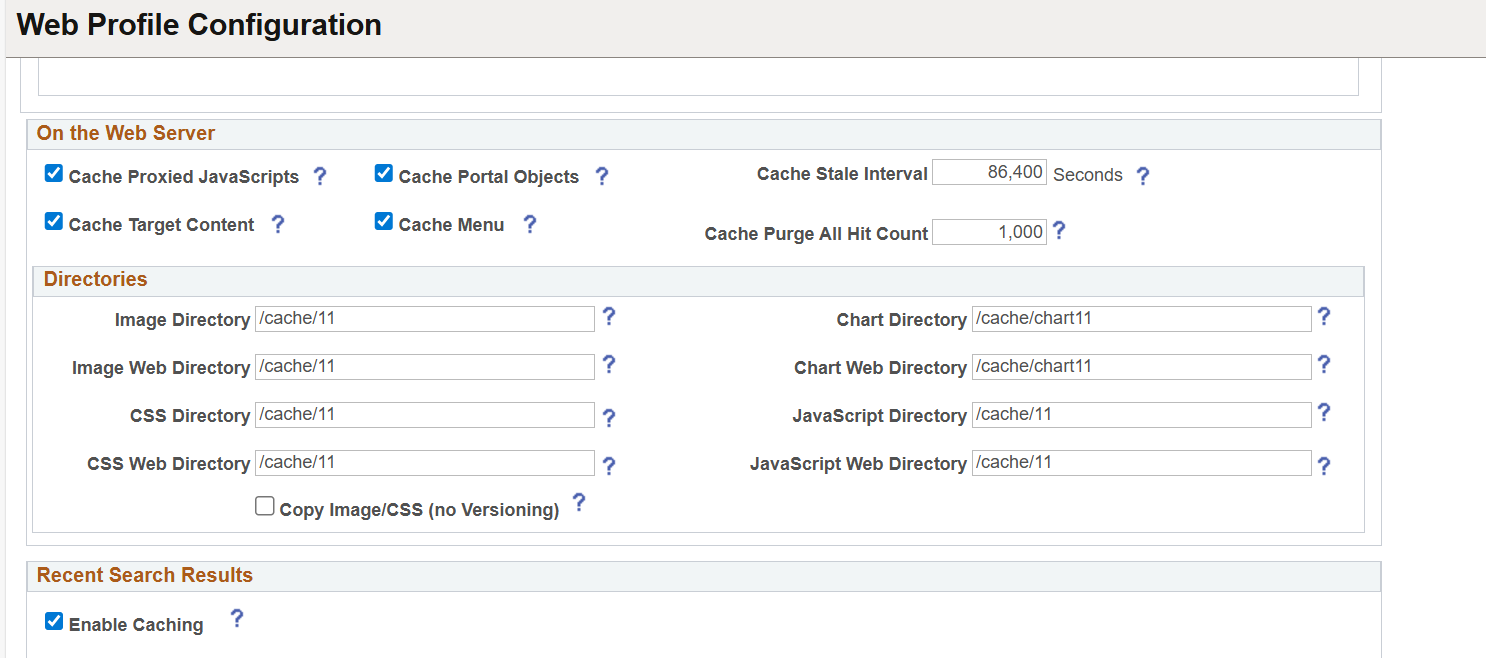
Hi - This is a classic PeopleSoft issue after a Tools upgrade. Users start getting random JavaScript errors or get kicked out because their browsers are serving cached JS from the previous Tools release. Since the filenames didn’t change, the browser says “same name, no need to download” and runs the old code against the new server—boom, chaos.What actually works: bump the cache version every time you upgrade. Change the cache folder/version so the JS URLs are new and the browser is forced to fetch fresh files. We’ve done this for five years—started at cache1 and we’re on cache11 now—and it reliably prevents the post-upgrade errors.
Please change like below and restart your webserver and hopefully it should resolve.
-Velu

Re: How can I make customizations to the body of the workflow notification for GLBATCH approval journals
HI Mariano,
If you are looking for customizing the workflow .You can open the wft file of the corresponding custom workflow in workflow builder and check the attribute or notification message to modify
Regards,
Ompriya

Re: Custom Fields in Reports
You can try BI Publisher within Agile.
You can find the details in the Agile Product Lifecycle Management Administrator Guide.
Regards,
SivaniG-Oracle
Re: crs alert.log after RU19.28 disappears
I have searched the official Known Issues document for Oracle Database 19c Release Update 19.28 but could not find any mention of this problem. Since this behavior is not officially documented as a known issue, it might be best to open a SR for further investigation.
Regarding the hypothesis that ADRCI caused the deletion:
An automatic purge based on the default one-year policy would not coincide exactly with a patch application. Although a manual PURGE command in ADRCI can delete the alert.log, this would be an intentional act. Since you have found no logs indicating that a purge command was executed, the theory that ADRCI was the root cause is unlikely.
Additionally, the fact that a new alert.log was created after subsequent RAC activity is completely standard Oracle behavior. Both the CRS and the database are designed to automatically create a new alert log file if one is not found when a new message needs to be written.
Cheers
Arsalan

Re: how to configure a user su to oracle user
Thanks for your post, however, whenever posting, please ensure to provide as much information of the issue as well as the underlying environment e.g. Linux distribution/release/update, kernel version, physical or virtual, hardware vendor/model, virtualisation solution/version, relevant package version, relevant component/configuration related information, etc.
With specific details, readers will be more inclined and able to offer specific responses, rather than generic suggestions.
That said, for security/privacy reasons, ensure not include any organisation/network/system/user, etc. specific information here to this public forum.
With regard to your issue, on a system utilising the default installed system configuration, no specific configuration is required to allow one user to su(1) to another. For regular users, as long as user1 has the correct credentials of user2, then switching to or running commands as user2 should simply succeed.
[user1@host ~]$ su - oracle
Password:
Last login: Thu Aug 14 13:10:50 AEST 2025 on pts/8
[oracle@host ~]$
What, if any, error or issue has prompted you to pose your question?
Depending on your distribution, review files /var/log/secure, /var/log/messages, etc. for any authentication related errors.

How to set up Counter for Revision Version in a Cost type BP Record?
Product Name - Primavera Unifier Cloud
How to set up Counter for Revision Version in a Cost type BP Record?
In a cost-type business process, such as Purchase Requisition or Purchase Order, it's common to have a need for revising documents..
Pls clarify is there any pre-defined data element available for Revision sequence for one particular document.
Re: Weekly ASCP always suggest in Sunday
Hi Aji,
Whether Sunday is working day in your manufacturing calendar?
Thanks
Re: Registered endpoint and 'sh acl'
Hi,
You are welcome. It is always nice to hear a praise.
- "The endpoint involved are individual IP phones that register with call agent via the SBC.
As such they are not configured as session-agents and if my understanding of your answer is correct they should go under the dynamic trusted category.
Correct ?" > > > > Yes, correct, all the individual IP phones are moved to dynamic trusted as soon as SBC adds them into registration cache / as soon as they get 200OK response to their REGISTER
- " I do see the their IP addresses under the 'sh registration sipd by-realm/by-route command'. Unfortunately, not even the 'show registration sipd by-user xxxxxx detailed' gives any indication of an individual IP address, trusted, untrusted, etc." > > > > > Actually you can see IP address of the IP phone in output "show registration sipd by-user xxxx detailed", it is shown in "User Agent Info" section.
- Whether it is "trusted or untrusted"? > > > > under normal circumstances a registered endpoint is always trusted (dynamicaly). There are special cases, like for example, a bandwidth depletion, where SBC puts the signaling messages (including registration attempts) into queue and the process itself can last longer than usual, up to 32 seconds. In such cases a record in registration-cache does not mean, that IP address of the phone is trusted. It can be in some intermediate state when SBC awaits for its second REGISTER to complete the registration.
- "If I may,
- As indicated, a dynamic endpoint that managed to successfully register goes under the 'Dynamic Trusted' category. If such an endpoint later crosses a threshold that should send it into untrusted or denied, will it show in the Untrusted or Denied section or will it just disappear from the Dynamic Trusted list ?" > > > > SBC will move this endpoint from "dynamic trusted" zone to "untrusted" zone at first and then to "denied" zone. Usually if some registered endpoint violates the thresholds, it will inevitably be banned after some time, so you will find it among other IPs in "show acl denied" output sooner or later. You will never find him in "show acl untrusted" output. Due to the same reason, ancient Acme Packet architects decided not to display each IP that enters untrusted allocation. Imagine what would happened to the output if someone started to attack SBC with REGISTER flood?
- " Will a dynamic endpoint that never succeded to register and crosses a threshold that should send it into denied, show in the Denied group ?" > > > > yes, absolutely. By the way, if this happens, you do not need to wait for the whole deny-period. You can manually remove him from denied zone with command "clear-deny"
Regards,
D
P.S. I apologize for my poor simplified english. I really hope my explanations are approximately understandable.

Re: Identify requisitions that have been completely canceled
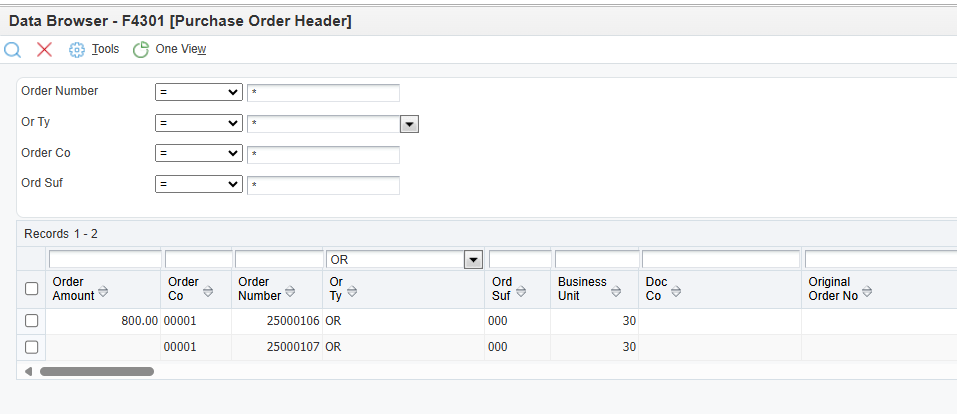
Thank you Angie; I created 2 OR orders and canceled one of them (row exit to Cancel line). In the Header, the only difference is that the open order still shows the Order Amount (order 25000106 below) - all other fields are identical.
We could raise an enhancement request under an SR if you'd like.
-Matt

Re: unable to complete olvm engine-setup
Hi There
Make sure oracle-ovirt-release-45-el8 is the latest version! "oracle-ovirt-release-45-el8-1.0-39.el8.x86_64" or later. The above should remove the exclusion of the slf4j-1.7.32 from /etc/dnf/dnf.conf it will also disable maven 3.5 and enables maven 3.8 module
So make sure that:
1- oracle-ovirt-release-45-el8 is version 1.0-39 or later
2- NO exclude="slf4j-1.7.32*" in /etc/dnf/dnf.con or /etc/yum.conf
3- That the follow output is true ( maven 3.5 is disabled and maven 3.8 is enabled)
#dnf module list |grep maven
maven 3.5 [d] common [d] Java project management and project comprehension tool
maven 3.6 common [d] Java project management and project comprehension tool
maven 3.8 [e] common [d] Java project management and project comprehension tool
If above is not true then just do
#dnf module reset maven:3.5
#dnf module enable maven:3.8
4- carry on with #engine-setup and say NO when asked to abort because you cannot turn back on slf4j-1.7.25
Hope above helps
Nash Oudha