Best Of
Re: New Org Setup Question
Hi Pete,
You will also need to look into migrating data from all your subledgers, you can't just point them to a new GL. So for AP, you would want to pay out as much as you are able, then move just the open invoices to the AP module under the new GL. For AR, you'll close out your receipt batches then move all the open invoices. AP and AR each have an interface table, and you could use sql to read the open invoices and load them into the interface table with the new ledger and operating unit info. For Assets, you'll need to convert them including the current status (original value, prior depreciation, current value, etc.). There is a webADI front end for Assets to do a Mass Load. You'll need to post to the GL; if you load the open items and then post, the GL journal should be only the conversion data; if you don't want to keep the journal then you can reverse it. In all cases, confirm that the total ending amount in the old ledger equals the total starting amount in the new ledger. Close all the periods in the old ledger, so it's there for reporting but can't be transacted.
Something to consider is whether you want YTD to be accurate. Suppose July is the open period. The simple thing would be to convert everything into July and check the inception-to-date values match. That does work, but be aware that YTD through June will be zero and MTD July will be the inception-to-date value, so that if you compare month-to-month or year-to-year, it won't be accurate. That isn't significant in some businesses. But if you want YTD to be accurate, then open Dec-2024 and convert ITD through Dec-2024 balances. Post and close, so Jan-2025 starts as it did in the original ledger. Then migrate Jan-25 from old to new, post and close, and continue each month. This approach gives you accurate ITD, YTD, and MTD values if you need them.
Good luck with your move,
J

Re: R12.2: Patch 37884085:R12.PAY.C - UPDATE MANITOBA & ONTARIO PROVINCIAL MEDICAL THRESHOLD UPDATES
Development confirmed that this is expected application behavior.
For Ontario, the previous thresholds were based on 2019 data. With Patch 37884085:R12.PAY.C, new thresholds effective from 2020 have been introduced, and the existing ones have been end-dated effective December 31, 2019. The customer will need to manually enter rates for the new thresholds which are effective from Jan 1st 2020 and later.
The same behavior also applies to the "Manitoba HAPSET Rate" user table changes delivered in this patch. (Existing row(s) is/are end-dated and you will need to enter the applicable rate(s) for the new threshold ranges.
Both the Manitoba and the Ontario changes are mentioned in the readme for Patch 37884085:R12.PAY.C.
To make it a little clearer, the readme has been updated indicating that after applying the patch, the existing user table values will be end dated, and you (the user) will need to enter the rate(s) as applicable to each province.

Re: CDR files not pushing to the FTP
ping works.
PING 172.16.9.77: 56 data bytes
64 bytes from 172.16.9.77: icmp_seq=0. time=0. ms
64 bytes from 172.16.9.77: icmp_seq=1. time=0. ms
64 bytes from 172.16.9.77: icmp_seq=2. time=0. ms
64 bytes from 172.16.9.77: icmp_seq=3. time=0. ms
pcap shows TCP connections originating from mgmnt interface on SBC.
Also FTP works from anywhere else using same logins.
 2918701
Re: Any good experiences using Oracle EAM Mass Manage work orders?
Yes, the work order advanced search doesn't support that.
Usually, the Mass Manage work order is used to change the status of work orders with the same status that share something in common, such as department, dates, area, or parent. etc, and you want to release them all, cancel, complete, etc
Gilad K
Re: Event Control logs in EAM Parameters
That sounds more like creating triggers and or audit trail on the fields/tables
Gilad K
Re: Browser cache issues after PeopleTools upgrade
Hi - This is a classic PeopleSoft issue after a Tools upgrade. Users start getting random JavaScript errors or get kicked out because their browsers are serving cached JS from the previous Tools release. Since the filenames didn’t change, the browser says “same name, no need to download” and runs the old code against the new server—boom, chaos.What actually works: bump the cache version every time you upgrade. Change the cache folder/version so the JS URLs are new and the browser is forced to fetch fresh files. We’ve done this for five years—started at cache1 and we’re on cache11 now—and it reliably prevents the post-upgrade errors.
Please change like below and restart your webserver and hopefully it should resolve.
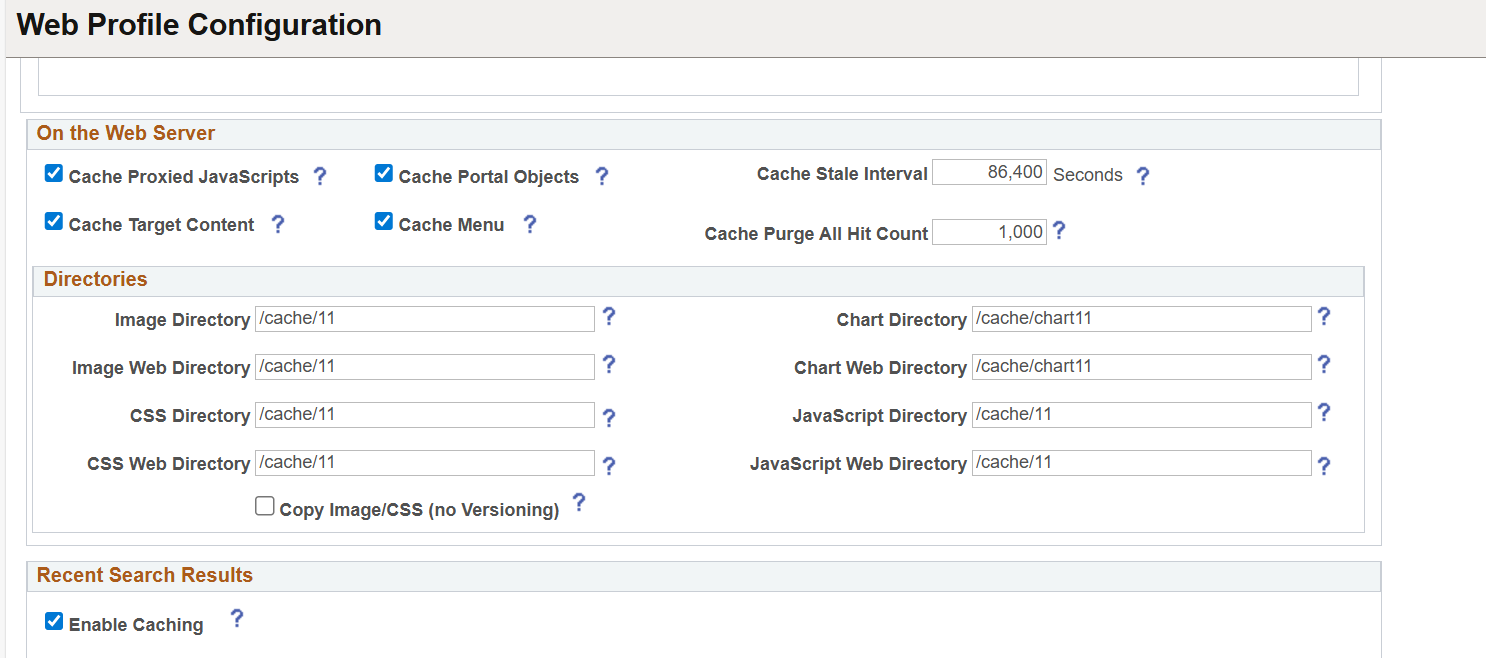
-Velu

Re: How can I make customizations to the body of the workflow notification for GLBATCH approval journals
HI Mariano,
If you are looking for customizing the workflow .You can open the wft file of the corresponding custom workflow in workflow builder and check the attribute or notification message to modify
Regards,
Ompriya
Re: Custom Fields in Reports
You can try BI Publisher within Agile.
You can find the details in the Agile Product Lifecycle Management Administrator Guide.
Regards,
SivaniG-Oracle
Re: crs alert.log after RU19.28 disappears
I have searched the official Known Issues document for Oracle Database 19c Release Update 19.28 but could not find any mention of this problem. Since this behavior is not officially documented as a known issue, it might be best to open a SR for further investigation.
Regarding the hypothesis that ADRCI caused the deletion:
An automatic purge based on the default one-year policy would not coincide exactly with a patch application. Although a manual PURGE command in ADRCI can delete the alert.log, this would be an intentional act. Since you have found no logs indicating that a purge command was executed, the theory that ADRCI was the root cause is unlikely.
Additionally, the fact that a new alert.log was created after subsequent RAC activity is completely standard Oracle behavior. Both the CRS and the database are designed to automatically create a new alert log file if one is not found when a new message needs to be written.
Cheers
Arsalan