Best Of
Re: WLS patch
Hello Team,
The way to check if the following Patch 38452573 - WLS STACK PATCH BUNDLE 12.2.1.4.250919
has already been applied to your environment is to run the "OPatch lsinventory" command, such as :
In Linux/Unix:
$ cd <DOMAIN_HOME>/bin
$ . ./setDomainEnv.sh ( please, notice the space between the 2 dots)
$ cd $MW_HOME/OPatch
$ ./opatch lsinventory > lsinventory.txt
In MS Windows:
cmd> cd <DOMAIN_HOME>\bin
cmd> setDomainEnv.cmd
cmd> cd %MW_HOME%\OPatch
cmd> opatch lsinventory > lsinventory.txt
Then, open lsinventory.txt in a text editor such a VI (on Linux) or Notepad (on Windows) and search for 38452573.
If 38452573 is found, then this Patch 38452573 - WLS STACK PATCH BUNDLE 12.2.1.4.250919 is applied to your WebLogic Server installation.
This information will help you too.
Best regards,
Stephan
Re: WHERE IS THE JDE UPDATE CENTER???
I have to clear browsing history and cookies. Then I can get past the 400 error.
Re: WHERE IS THE JDE UPDATE CENTER???
Update Center is still where it was -
So the links should still be okay…but as @Rochelle S. already said, there's something wrong with the combination of a modern browser and the page over the last few months. Only works on chromium-based browsers for me or on Incognito Firefox 🤷

How to download multiple patches at once
In the old MOS it was possibile to select mutiple patches and a "download" button would popup, allowing you download a list of patches by simply clicking on each patch name.
With this new MOS I can still select mutiple patches, but there's no download button:
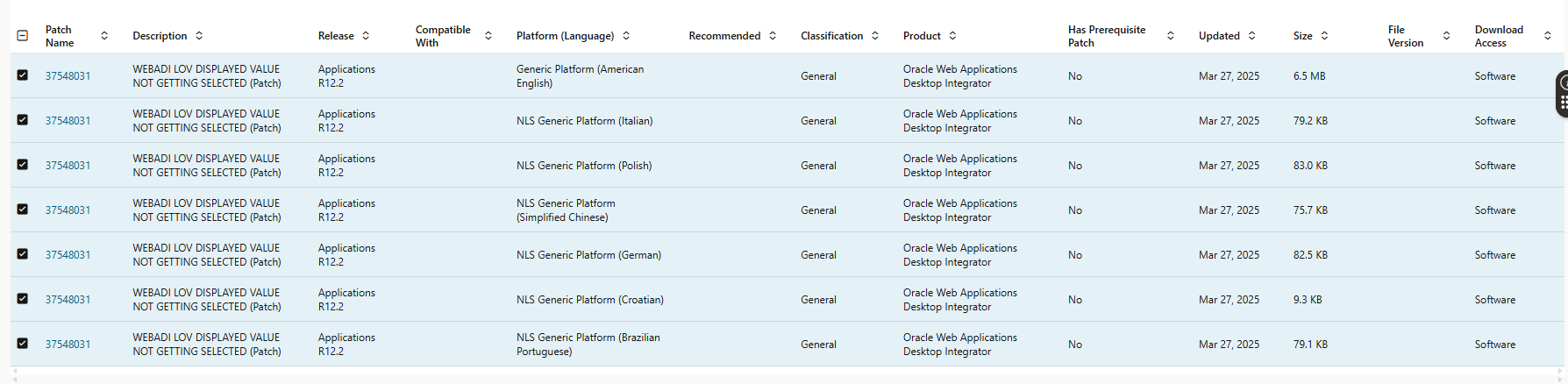
What's the purpose of the check box on the left side if then I still have to open each patch to finally reach the download button?
This new support portal is the worst I've seen in ages.
 Fr4nk
Re: Error: Update of this column is not allowed because Printed, Posted, or Applied Transaction(s) exist
This is solution for your issue
Responsibility: Receivables Manager
Navigation: Setup > System > System Options
Select the Trans and Customers tab
Enable the checkbox "Allow Change to Printed Transactions"
Save the change.
Best Regards.
Moustafa Fadel.
Re: E1 31 How to know which components are pending to issue
Hello,
The closest report that I found that provides the information you're looking for is the Material Usage Variance Report (R31426). Perhaps you could use this batch program with a filter on open Work Order statuses (e.g., SRST greater than 40, and SRST less than 95). This report shows the usage percent for both units and cost:
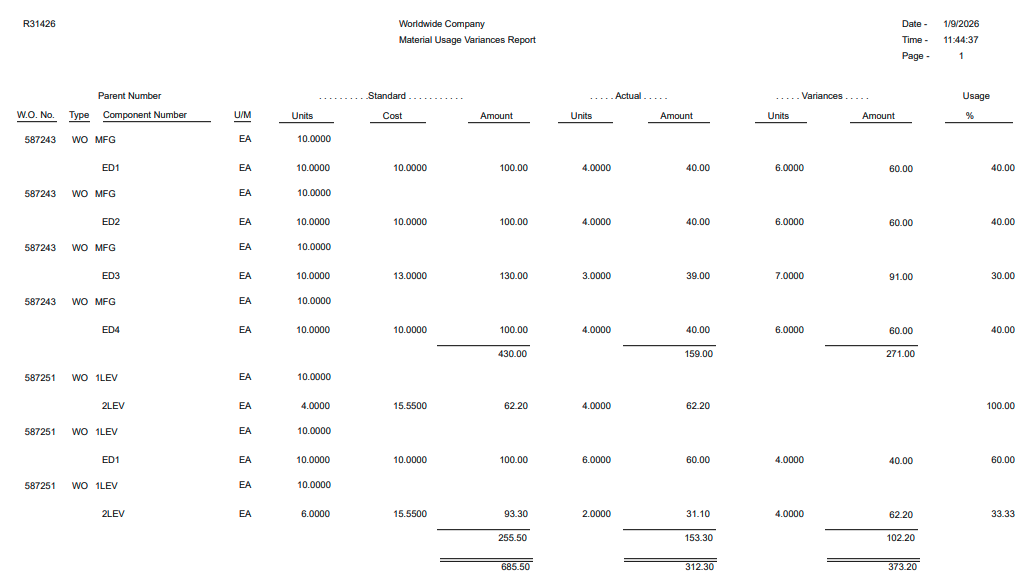
Another option could be to use the V3111JC business view (table join on F3111, F4801 and F4801T), and in databrowser, create a query using the Work Order Status and a comparison between the Transaction Quantity and the Quantity Ordered.
Many thanks,
Eric
Re: How to prevent SBC from using RURI host of a received REGISTER as a next-hop?
Tim,
I have applied a HMR that replaces RURI host with the local IP of the ingress sip-interface. With 30000 registrations on the sip-interface it does not affect the sipd load, although to me it seems bit odd - to manually fix the default behavior of SBC. I have checked also non-IMS deployment, and it behaves in the same manner, so this is not IMS specifics.
Regards.
Daureen

Re: Who Creates Item Catalog Entries in Your Organization and How?
Sorry Wendy I wasn't clear enough! I meant item master (define item).
For suppliers that you don't have punchout for, and don't get an item catalog, what's the business process for defining items (to prevent your users from just buying any item randomly from any supplier).
Re: Who Creates Item Catalog Entries in Your Organization and How?
No worries at all.
One caveat- we are still using the non-fluid ePro Requisition, vs the Fluid Requisition.
Our organization has a group that manages the creation of items in define item only. We have rules around when an item ID is necessary or if it's a onetime special request that does not have an item ID.
Procurement users are then responsible for adding and maintaining purchasing attributes- price, lead time, suppliers, auto sourcing and the like.
Most of our requests for items are driven by replenishment or external sources, which looks at the items purchasing attributes set up. For the one manually created requisitions, the priority 1 supplier populates on the requisition. Since most of our items are set to auto source, even if the requester enters a different supplier, it's still sourcing to the priority 1 supplier in purchasing attributes. I believe this is just part of the delivered sourcing processes.
We have these processes scheduled to run several times a day.
I do know if someone manually sources the requisition (expedite requisitions), it takes the supplier provided though. In those cases, no one would know any better.
As far as how, we actually do item creation and maintenance in an external system. The item definition and some pieces of purchasing attributes are integrated into PS. For new items, the group that creates and maintains the item master can send a supplier and the lead time as part of the data. They cannot send the supplier or lead time if they are making an update to the item master.
We have category managers that maintains large groups of items, typically based on contracts with specific suppliers so pricing is updated via a CI on a regular basis. Outside of that users in Procurement are responsible for maintaining the item's purchasing attributes.
For supplier changes, pricing updates and such, our admin team (me and others) can run an excel to CI to update large volumes for Procurement and do on a regular basis. Anything under 30-40 items, they would manually maintain.
Holler if you have questions, glad to help
Wendy🐞