Best Of
Re: Where have my bookmarks in Knowledge gone??
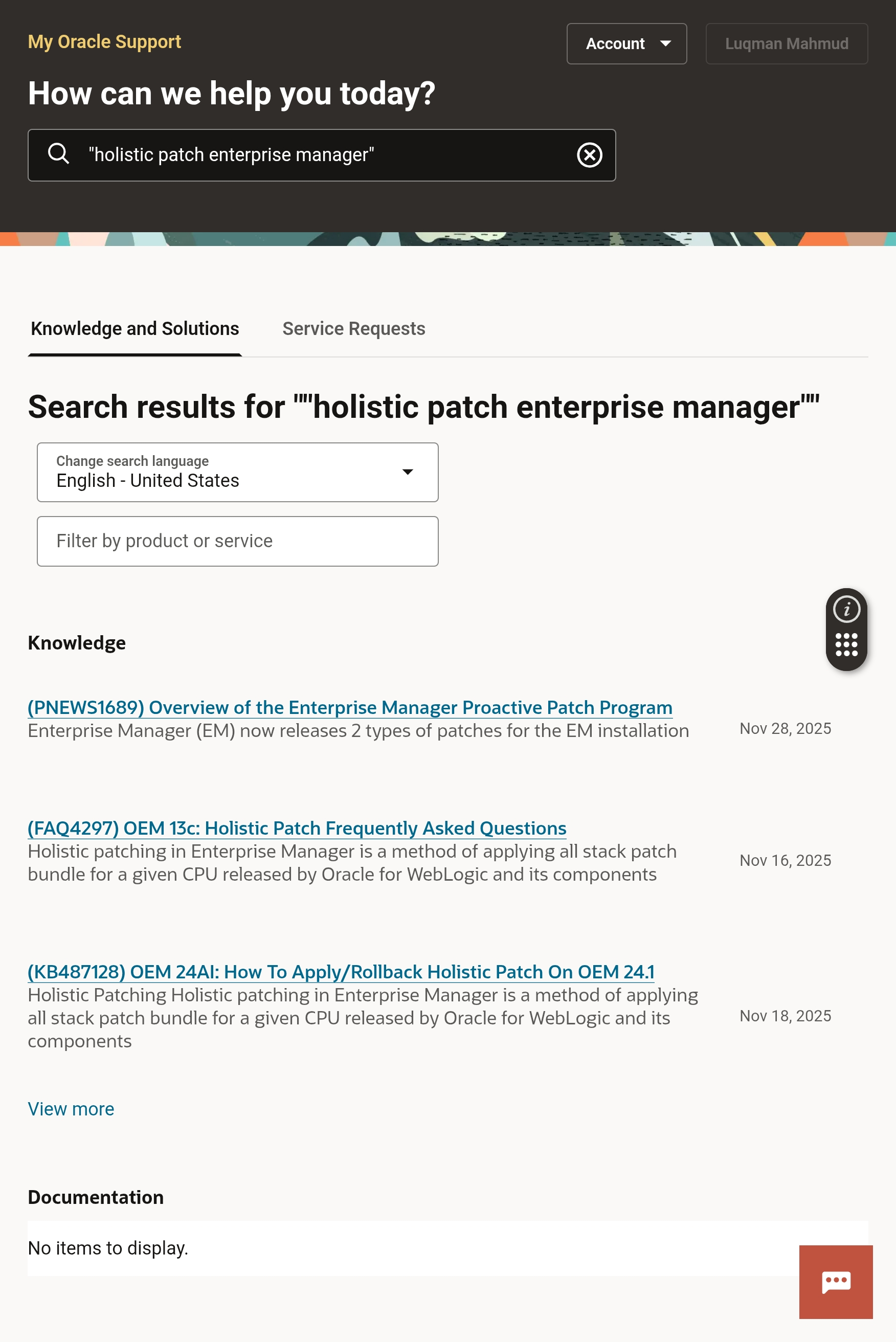
It took me nearly 2 hours to figure out how to find the latest holistic patch for OEM. Searching on "holistic patch enterprise manager" doesn't even give you the link to the holistic patch.
 LukeInDC
Re: Who designed this new MOS without customer testing? (my honest feedback)
Totally agree, is there a petition open to bring back the old portal till they offer something even remotely equivalent ?
Re: Who designed this new MOS without customer testing? (my honest feedback)
I'm really not understanding
Is a company in the size of Oracle easy to make such mistakes?!! Is a company like Oracle the most demanded and used database which sells migration services to customers across the globe possible to do such silly mistake? go production without testing?? without having rollback plan?? and for how long ?? complete full days now?
It's really annoying and furstrating

(Doc ID 3050869.2) Enterprise Manager 24ai Main Release Update List (Includes Plug-ins)
How to find the document: (Doc ID 3050869.2) Enterprise Manager 24ai Main Release Update List (Includes Plug-ins) ?
Re: Where have my bookmarks in Knowledge gone??
At least it seems that now Oracle is aware of all the issues of the new MOS.
However I'd like to hear from Oracle what is the justification for not having taken care of all those problems before launching the new portal, and not after. All of these issue would have been very easy to spot if someone actually tested the new portal before opening to the public. Also, the new MOS has already been live for quite some time for the SaaS and PaaS products, and all the same issues already existed back then.
So the only possibile explanation is that nothing has been actually tested, which I find offensive given the amount of money we pay every year in support fees.
Fr4nk
Please, make Knowledge Base documents more friendly for external bookmarking tools
I hope Oracle reads posts here and I have constructive request related to Bookmark feature. Official advice is to start using external tool to organize bookmarks and this might not be bad idea.
However current knowledge base articules are very unfriendly to bookmark by browsers. Title does not include any information about the note, it is just "Knowledge Article", but should be at least KB number in it. The same happens when printing to PDF - proposed name is always the same as it probably taken from title. Moreover document title is only visible in the left small windows where it is usually shortened and it is impossible to copy it to clipboard - so how to we suppose to organize our bookmars?
Tools like Zotero (https://www.zotero.org/) honor additional metadata helping in such case, the standard is described here:
So, my request is: please make site friendly to external bookmarking tools.
Regards,
Michal
mickyw
Re: start-marked documents
it's all the documents I have marked - to keep in my account - like next coming patches schedules, which jdk is allowed to AIX and Linux 64 for OEM and oracle database and more
Enterprise Manager 13.5 Main Release Update List (Includes Plug-ins) (Doc ID 2760230.2)
Overview of the Enterprise Manager Proactive Patch Program (Doc ID 822485.1)
Critical Patch Update (CPU) Program Oct 2024 Patch Availability Document (EM-only) (Doc ID 3036947.1)
EM 13.5 : How to Use the Latest Certified IBM JDK 8 Update With EM OMS / Agent Running on AIX Servers? (Doc ID 2785429.1)
Re: Clean DMU error on SYS.EXP_HEAD$ with dbms_stats.reset_col_usage
Ah yes much better with longer display ;)
Then, atfer I scan database on DMU, I have hundreds errors in SYS.EXP_HEAD$.TEXT and I have REPORT_COL_USAGE on all schemas.
...
After I run RESET_COL_USAGE on each schema, no more reports:
SQL> SELECT DBMS_STATS.REPORT_COL_USAGE(NULL, NULL) FROM DUAL;

DBMS_STATS.REPORT_COL_USAGE(NULL,NULL)
--------------------------------------------------------------------------------
No column usage information to report
Then I rescan table SYS.EXP_HEAD$ on DMU. I still have a 3 errors in SYS.EXP_HEAD$.TEXT and I have SYSTEM reports back:
SQL> SELECT DBMS_STATS.REPORT_COL_USAGE(NULL, NULL) FROM DUAL;

DBMS_STATS.REPORT_COL_USAGE(NULL,NULL)
--------------------------------------------------------------------------------
LEGEND:
.......

EQ         : Used in single table EQuality predicate
RANGE      : Used in single table RANGE predicate
LIKE       : Used in single table LIKE predicate
NULL       : Used in single table is (not) NULL predicate
EQ_JOIN    : Used in EQuality JOIN predicate
NONEQ_JOIN : Used in NON EQuality JOIN predicate
FILTER     : Used in single table FILTER predicate
JOIN       : Used in JOIN predicate
GROUP_BY   : Used in GROUP BY expression
...............................................................................

###############################################################################

COLUMN USAGE REPORT FOR SYSTEM.DUM$TABLES
.........................................

1. AVAILABLE_LOGGING                   : EQ
2. CONVERT_METHOD                      : EQ
3. DICTIONARY                          : EQ
4. MIGRATION_STATUS                    : EQ
5. MTIME                               : NULL EQ_JOIN NONEQ_JOIN
6. OBJ#                                : EQ EQ_JOIN
7. OWNER#                              : EQ
8. SCAN_END                            : NULL
9. USED_SIZE                           : RANGE NULL
10. (AVAILABLE_LOGGING, SCAN_END,
     MIGRATION_STATUS, CONVERT_METHOD) : FILTER
###############################################################################

###############################################################################

COLUMN USAGE REPORT FOR SYSTEM.DUM$TABLE_CHUNKS
...............................................

1. MIN_ROWID                           : EQ
2. OBJ#                                : EQ
###############################################################################

###############################################################################

COLUMN USAGE REPORT FOR SYSTEM.DUM$COLUMNS
..........................................

1. ADDED_SIZE                          : NULL
2. CHANGELESS                          : NULL
3. CONVERTIBLE                         : RANGE NULL
4. HASH                                : EQ EQ_JOIN
5. INTCOL#                             : EQ_JOIN
6. INVALID                             : RANGE NULL
7. OBJ#                                : EQ EQ_JOIN
8. OVER_LIMIT                          : RANGE NULL
9. SCAN_END                            : NULL
10. SCAN_STATUS                        : EQ
11. SCHEDULED_CHANGELESS               : NULL
12. SCHEDULED_CONVERTIBLE              : NULL
13. SCHEDULED_INVALID                  : NULL
14. SCHEDULED_LOSE_DATA                : EQ
15. SCHEDULED_NO_CONVERSION            : EQ
16. SCHEDULED_OVER_LIMIT               : NULL
17. SCHEDULED_TOO_LARGE                : NULL
18. SCHEDULED_TYPE#                    : NULL
19. TOO_LARGE                          : RANGE NULL
###############################################################################

###############################################################################

COLUMN USAGE REPORT FOR SYSTEM.DUM$EXCEPTIONS
.............................................

1. OBJ#                                : EQ
###############################################################################
After I RESET_COL_USAGE on SYSTEM, no more report:
SQL> exec dbms_stats.reset_col_usage('SYSTEM',null);

Procedure PL/SQL terminee avec succes.

SQL> SELECT DBMS_STATS.REPORT_COL_USAGE('SYSTEM', NULL) FROM DUAL;

DBMS_STATS.REPORT_COL_USAGE('SYSTEM',NULL)
--------------------------------------------------------------------------------
No column usage information to report

SQL> SELECT DBMS_STATS.REPORT_COL_USAGE(null, NULL) FROM DUAL;

DBMS_STATS.REPORT_COL_USAGE(NULL,NULL)
--------------------------------------------------------------------------------
No column usage information to report
Again I rescan table SYS.EXP_HEAD$ on DMU. I still have a 3 errors in SYS.EXP_HEAD$.TEXT and Istill have SYSTEM reports :
SQL> SELECT DBMS_STATS.REPORT_COL_USAGE('SYSTEM', NULL) FROM DUAL;

DBMS_STATS.REPORT_COL_USAGE('SYSTEM',NULL)
--------------------------------------------------------------------------------
LEGEND:
.......

EQ         : Used in single table EQuality predicate
RANGE      : Used in single table RANGE predicate
LIKE       : Used in single table LIKE predicate
NULL       : Used in single table is (not) NULL predicate
EQ_JOIN    : Used in EQuality JOIN predicate
NONEQ_JOIN : Used in NON EQuality JOIN predicate
FILTER     : Used in single table FILTER predicate
JOIN       : Used in JOIN predicate
GROUP_BY   : Used in GROUP BY expression
...............................................................................

###############################################################################

COLUMN USAGE REPORT FOR SYSTEM.DUM$TABLES
.........................................

1. MTIME                               : NULL EQ_JOIN NONEQ_JOIN
2. OBJ#                                : EQ_JOIN
3. USED_SIZE                           : NULL
###############################################################################

###############################################################################

COLUMN USAGE REPORT FOR SYSTEM.DUM$TABLE_CHUNKS
...............................................

1. MIN_ROWID                           : EQ
2. OBJ#                                : EQ
###############################################################################

###############################################################################

COLUMN USAGE REPORT FOR SYSTEM.DUM$COLUMNS
..........................................

1. CONVERTIBLE                         : RANGE
2. HASH                                : EQ EQ_JOIN
3. INTCOL#                             : EQ_JOIN
4. OBJ#                                : EQ EQ_JOIN
5. SCAN_STATUS                         : EQ
6. SCHEDULED_CHANGELESS                : NULL
7. SCHEDULED_CONVERTIBLE               : NULL
8. SCHEDULED_INVALID                   : NULL
9. SCHEDULED_LOSE_DATA                 : EQ
10. SCHEDULED_NO_CONVERSION            : EQ
11. SCHEDULED_OVER_LIMIT               : NULL
12. SCHEDULED_TOO_LARGE                : NULL
###############################################################################

###############################################################################

COLUMN USAGE REPORT FOR SYSTEM.DUM$EXCEPTIONS
.............................................

1. OBJ#                                : EQ
###############################################################################
Finally I reset all, no more report:
SQL> exec dbms_stats.reset_col_usage(null,null);

Procedure PL/SQL terminee avec succes.

SQL>  SELECT DBMS_STATS.REPORT_COL_USAGE('SYSTEM', NULL) FROM DUAL;

DBMS_STATS.REPORT_COL_USAGE('SYSTEM',NULL)
--------------------------------------------------------------------------------
No column usage information to report
and no more error on DMU when I rescan SYS.EXP_HEAD$ table.
Isn't this a strange behaviour?
Dag Ubx
Re: how to create form personalization to prenven user delete ar receipt ?
Hi
You should try Forms Personalization.
Best Regards,
Bharat
Re: how to create form personalization to prenven user delete ar receipt ?
You could try exclusions on the menu. In a Test instance, in System Administrator, go to Security > Responsibility > Define. Query the responsibility. In the bottom half of the form are Exclusions - anything added here is blocked for the responsibility. Select function and Receipt: Delete and save. You may also want to select function Miscellaneous Receipt: Delete to be thorough, and maybe use the list of values to check any other deletions available and decide whether to restrict those. Save your changes. Go to the responsibility and confirm that it's not possible to delete. Always confirm since some functions can have similar names so you need to make sure you get the right one.
If that doesn't work, you can add a personalization to disable the Delete button. The personalization would fire on new item. The action would be taken on the Delete button and the action would be to disable. You can add a message if you like, but you don't need to.
When you test, be sure to test both clicking the Delete icon and pressing the Delete key on the keyboard.